


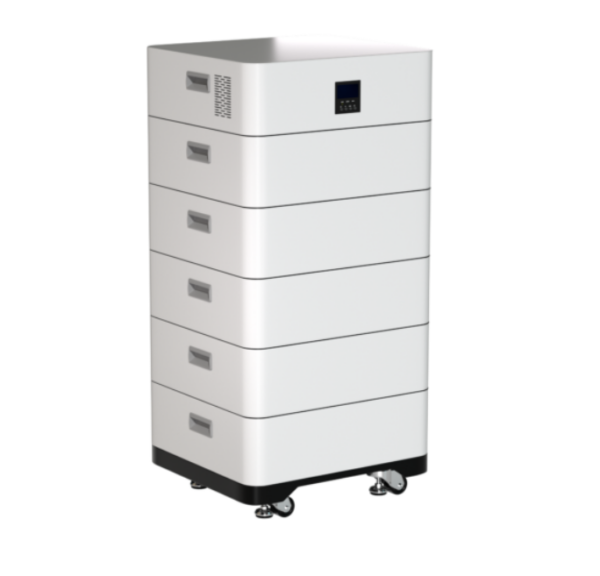


OFF-GRID RESIDENTIAL
- 6,000 deep discharge cycles at 15–90% (DOD)
- Leak-proof and therefore fire-safe technology
- Industrial Prisma AA+ battery cells
- The battery always comes with its own BMS and hybrid inverter—no hassle or surprises with hardware and software.
- Competitive pricing for absolute top-tier technology
- Optional on-grid or off-grid use
- Up to 20 kWh output at 230V (LV); from 24 kWh: 400V for higher efficiency (HV)
- 10-year unlimited warranty on the battery
- Service life of at least 20 years under intensive charge cycling
- Expandable capacity up to 450 kWh
- Inverter output from a minimum of 6 kW up to 450 kW (parallel), depending on battery capacity (per 20 kW block)
- Delivered in consultation as a package for DIY installation or installed by our own installation team, subject to a separate quotation
- Wind turbine, water turbine, power generator, grid, control panel, AC/DC, PV installation—48V to 400V output; all connections possible in both directions
- Capacity tariff monitoring via the inverter, with full remote control via an app on your phone
- In on-grid mode, the system is monitored by central dispatching (free service)
- Automatic updates for technical changes, as well as updates from legislators or the grid operator
How can I get more out of my PV installation – or even better: how can I go off-grid at home?
Many solar panel owners are noticing that their investment is yielding less and less. Smart meters, prosumer tariffs, and new taxes make it difficult to use solar power optimally. Where it used to be attractive to use the grid as a battery, that function is now gradually disappearing.
That’s why more and more people are choosing energy management through residential off-grid solutions—systems that allow you to store your own energy and become independent from the electricity grid.
Why switch to a residential off-grid system?
The current energy market makes it clear that self-sufficiency is the future. Smart meters are being rolled out everywhere, and traditional “old” meters will be phased out completely by 2025. This means you can no longer feed back the solar power you generate during the day in the same way as before.
With a residential off-grid battery system, you can store surplus energy during the day and use it when you really need it— in the morning, in the evening, or during dark winter days. This way, your home always remains supplied with power, without depending on grid operators or rising tariffs.
Choosing the right technology
Not every battery is suitable for long-term use. Cheap lead-acid batteries may seem attractive, but they have a short service life and a low number of charge cycles.
Javac’s LiFePO₄ batteries, on the other hand, are designed for intensive applications, with more than 5,000 charge cycles (DOD) and a service life of up to 20 years.
The Javac Power Edge Powerbank combines these high-quality batteries with a hybrid inverter and intelligent BMS, ensuring safe operation and maximum efficiency. Do you have 6 to 10 kW of solar panels or a small wind generator? Then this is the ultimate solution for a residential off-grid energy system.
What does a residential off-grid system cost?
The total cost depends on your daily consumption and the desired autonomy.
An 11.4 kWh Powerbank with integrated BMS and inverter is already available between €12,500 and €15,000 + VAT (6%).
This gives you sufficient capacity for a conventional household, with the option to add a wind generator or a small diesel/gas generator for extra security during the winter months.
Complete independence
More and more families are choosing to go fully residential off-grid—so they are no longer dependent on rising energy prices, peak-demand charges, and uncertain regulations.
With Javac’s solutions, you benefit from:
Continuous power supply, 365 days a year
Minimal maintenance requirements
Automatic software updates
Full control via an app
An 11.4 kWh system provides sufficient power for everyday residential use, with minimal fuel consumption of only 100 litres per year when using a backup generator.
Contact us with no obligation for the right professional solution.
| Technical specification | Value |
|---|---|
| Depth charge (DOD) | 6000 cycles (15-90%) |
| Battery capacity (base) | 11.4 kWh |
| Power solar panels | Minimum of 6 - 10 kW recommended |
| Output low voltage (LV) | up to 20 kWh, 230 V |
| Output high voltage (HV) | up to 24 kWh, 400 V |
| Power | up to 450 kWh |
| Output power vio inverter | 6 kW - 450 kW (in parallel, per block of 20 kW) |


Reviews
There are no reviews yet.